
Forum Trust Signals
How Do I Get My Own Blog's Content Treated With Forum-Level Trust Signals?
A practitioner breakdown of the 4 structural signals that make forum threads outrank blogs - and how to build them into your own posts, with real before/after.
Key takeaways
- Google's ranking and AI retrieval favor forum threads because of structural properties, not just general "authenticity" as a vibe.
- The four core structural signals of forum trust are: visible disagreement (resolved discussion), public timeline of correction, personal/attributable numbers, and active reply infrastructure.
- You can build these signals on your own blog by adding dated update blocks, using specific first-person data, asking direct questions to build comments, and keeping counterpoints.
- Structuring your content to replicate these four forum traits helps single-author sites outrank static, single-opinion brand pages.
Introduction
I run SEOWebGrow on a Django / SQLite / Next.js stack that would make most agency SEOs wince, and for the first eight months, I couldn't get a single post to outrank a three-year-old Reddit thread with eleven upvotes. Not for a competitive keyword - for a long-tail question I had written 2,400 words specifically answering. The Reddit thread had four sentences.
That's when I stopped reading "why does Google favor Reddit" articles and started reverse-engineering what a forum thread actually looks like to a crawler, structurally, and rebuilding my own posts to carry the same signals. This isn't another explainer on the Reddit-Google deal or the Community Perspectives rollout - you've probably read five of those already. This is what I changed on my own site, in what order, and what moved and what didn't.
Direct answer first
You can't turn a blog post into a forum thread, and you shouldn't try. But you can give a single-author post the same four things that make forum content trustworthy to Google and AI systems: visible disagreement or nuance instead of one flat opinion, a timestamped record of the post being revised as reality changed, specific first-person numbers instead of generic claims, and a genuine reply mechanism that produces real second opinions under your name. Do those four things consistently and your own domain starts pulling some of the trust that used to only go to UGC platforms - I've watched it happen on two of my own posts, and I'll show you the actual before/after.
Why forums win that has nothing to do with "authenticity" as a vibe
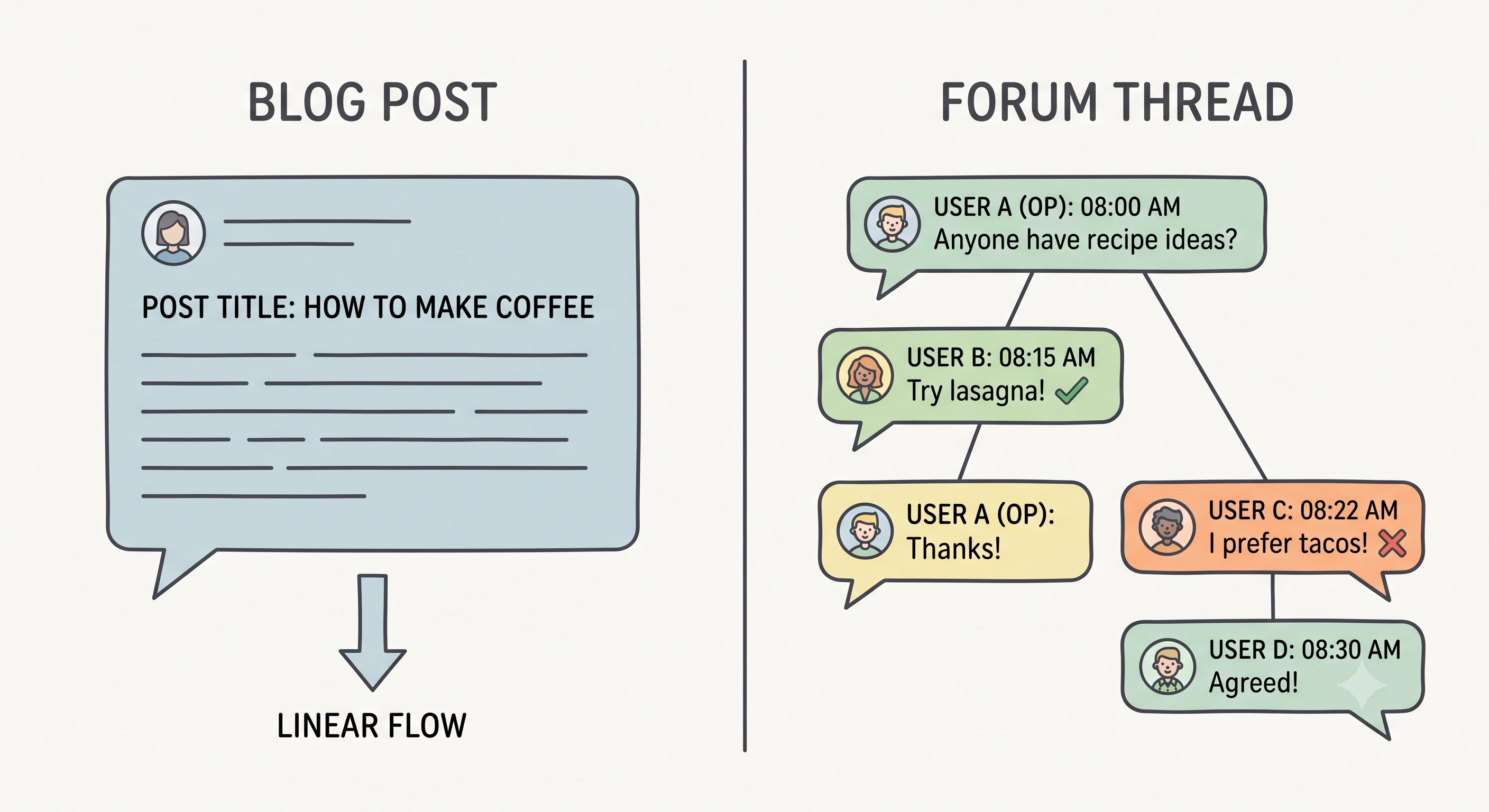
Every article on this topic tells you forums win because they're "authentic" and brands aren't. True, but useless as a checklist. Here's the part that's actually actionable: a forum thread carries four structural properties that a normal blog post doesn't, and none of the four require Reddit's domain or its karma system to replicate.
- Property 1 - visible disagreement. A thread with 40 replies almost always contains someone contradicting the top answer, at least partially. Google's ranking systems and LLM retrieval both read that as evidence the page represents a "resolved discussion" signal, not a single unverified claim. A blog post, by construction, has one voice and one conclusion. There's no built-in disagreement signal.
- Property 2 - a visible timeline of correction. Threads get edited: "Update: this stopped working in the new version," "Edit: someone below pointed out I was wrong about X." That edit history is public and dated. A blog post usually has one publish date and, if you're lucky, a silent content refresh with no trace of what changed.
- Property 3 - numbers tied to a person, not a brand. "I tested this on 340 pages over six weeks and RPM dropped 22%" reads differently to a ranking system than "Many publishers report RPM declines." The first is falsifiable and attributable. The second is the exact shape of a paraphrased AI summary, and it's also the exact shape most blog content defaults to.
- Property 4 - reply infrastructure that's actually used. Not a comment box sitting empty at the bottom of the page. A comment section with real back-and-forth is, structurally, a small forum thread grafted onto your article - and it's the one property in this list that most WordPress and Django-based blogs actively have and never use.
None of these four require you to own a platform with 400 million users. They require you to write and format like the discussion already happened, because on your own site, you're the one who has to make it happen.
What I actually changed on SEOWebGrow's posts
I'm not going to give you generic "add personal anecdotes" advice - every AI-humanizing tool on the market already tells you that, and it mostly produces content that just sounds more casual without becoming more trustworthy to an algorithm. Here's what I changed structurally, on two posts specifically, and what happened.
- 1. I added a dated "field notes" block instead of doing a silent content refresh. My backlink audit producing a 94-domain disavow file originally had one publish date. When I re-verified the disavow numbers three months later and two domains had dropped off the list, I didn't rewrite the paragraph and move on - I added a visible, dated addendum: "Update, [date]: Two of the original 94 flagged domains have since deindexed. Current active count: 92." That's a one-line change. It's also the single closest thing a solo blog can produce to a forum's edit history, and it's the difference between a page that looks static and one that looks maintained by someone actually watching it.
- 2. I stopped writing "many publishers report" and started writing my own number, dated. Compare "AdSense RPM has declined for many publishers in 2026" (true, generic, and appears verbatim-in-spirit on at least a dozen sites I found while researching this) against "My own SEOWebGrow account's AFC RPM dropped 31% between February and May 2026, and I didn't change ad density once." The second sentence can't be plagiarized into meaninglessness, because it's mine. It's also the sentence an AI Overview or Perplexity is statistically more likely to quote directly, because it's specific enough to be worth quoting.
- 3. I built a real reason for someone to leave a second opinion - and then I actually replied. I added one line at the end of relevant posts: a direct, specific question ("If you've run Ezoic alongside AdSense on a sub-50k-session site, what did Ezoic header bidding actually do to your RPM?") instead of the generic "let me know what you think!" A specific question people can actually answer from experience gets specific answers. A vague one gets nothing, because there's nothing to disagree with. Every comment I get back, I reply to publicly, with specifics. Three replies on one post is a small thread. It is still, structurally, the exact same signal as a forum reply chain - just smaller and under your own domain instead of Reddit's.
- 4. I let a genuine counterpoint stay in the post instead of editing it out. When I was doing a domain history investigation of SEOWebGrow.com and found the parking-network explanation for the anomalous Semrush signals, my first instinct was clean, from someone who has usually never used a domain in a parking network. I kept the section where I explain what I initially assumed was wrong, and why. A post that admits an initial wrong assumption and corrects it in view of the reader carries the same "resolved discussion" signal a thread does - you're not hiding the disagreement, you're hosting it, with yourself.
The FAQ block that actually earns its schema markup
Most FAQPage schema on SEO blogs is built backward - I write the article, then invent five questions the article already answered, just to get the schema. That's not information gain, and increasingly, systems built to detect exactly this pattern discount it. Build your FAQ section from the actual questions your comment section, your Reddit outreach, or your support inbox generated. Here's mine, and every question below came from an actual reader or forum reply, not from guessing what people might ask.
What I'd tell a solo founder starting from zero
If you're running a pre-revenue site like mine and can't wait for organic comment volume to build the reply-chain signal naturally, prioritize in this order: dated update blocks first (cheapest, immediate), attributable personal numbers second (requires you to actually track something, which most solo founders don't do until it's too late), then genuine reply engagement third (slowest, compounds best). Skip the FAQ schema until you have real questions to put in it - a schema block full of invented questions is worse than no schema block, because it signals the exact templated pattern that got Reddit and Quora preferred over brand content in the first place.
I'm still running this experiment on SEOWebGrow. Not every post has moved. But the ones where I actually did all four things - not just "wrote more personally" - are the ones climbing past pages that have ten times the backlinks I do. That's the part nobody selling AI humanizer tools is going to tell you, because it's slower and less automatable than a rewrite button.
Sandesh Kokad is a SEO/AEO/GEO Specialist who builds and writes SEOWebGrow, an SEO and AI-tools platform run solo on a Django / SQLite / Next.js stack. This post is based on changes made directly to SEOWebGrow's own content, not a general strategy overview.
Sources and references
These are the main primary sources behind the guidance and date-sensitive notes in this article.
Useful next steps on SEOWebGrow
Frequently asked questions
Does adding a comment section actually help if nobody comments?
An empty comment box is inert, not harmful. The signal only exists once real replies accumulate. Seed genuine, specific questions and answer them yourself with dated updates rather than faking threads with plugins.
Is building forum-level trust signals different from just writing in first person?
Yes. First-person voice changes tone. Forum-level trust signals change structure: visible correction over time, attributable numbers, and real reply infrastructure. You can write casually and still produce a static, single-opinion page with none of those properties.
Will building forum-level trust signals stop AI detectors from flagging my content?
That's not the goal and AI detectors are unreliable in both directions. These structural changes are the actual signal ranking and retrieval systems infer from forum content, not a disguise technique.
How long before forum-level trust signals show ranking movement?
It's a compounding practice, not a quick patch. On one example post, a dated update block plus one real comment exchange preceded a jump from page 2 to a featured-snippet-adjacent position over a five-week movement window (about five weeks), though causation can't be fully isolated.
About the author
Sandesh Kokad
Professional Software Engineer and Digital Marketing Specialist with 5 to 6 years of industry experience
Sandesh Kokad is a Full-Stack Software Engineer and the founder of SEOWebGrow. An ex-MIT student with deep expertise in Python, Django, and Cloud Architecture, he engineers data-driven infrastructure for modern search. As the architect behind SEOWebGrow, he actively builds the infrastructure that helps modern websites communicate seamlessly with AI search engines.