
Beginner GEO Guide
What Is GEO? A Simple Guide to Generative Engine Optimization and AI Search
Learn what GEO means in simple words, how AI search works, how it connects with SEO, and what brands should do to get cited in AI answers and AI search results.
Key takeaways
- GEO means improving your chances of being cited, linked, and trusted in AI-driven answers.
- Classic SEO still matters because AI systems still depend on crawlable, clear, reliable web content.
- You do not need special AI-only schema or a secret GEO trick. You need strong pages, structure, and evidence.
- Brands that build topical depth, internal links, author trust, and clear facts are easier for AI systems to use.
What GEO means in simple words
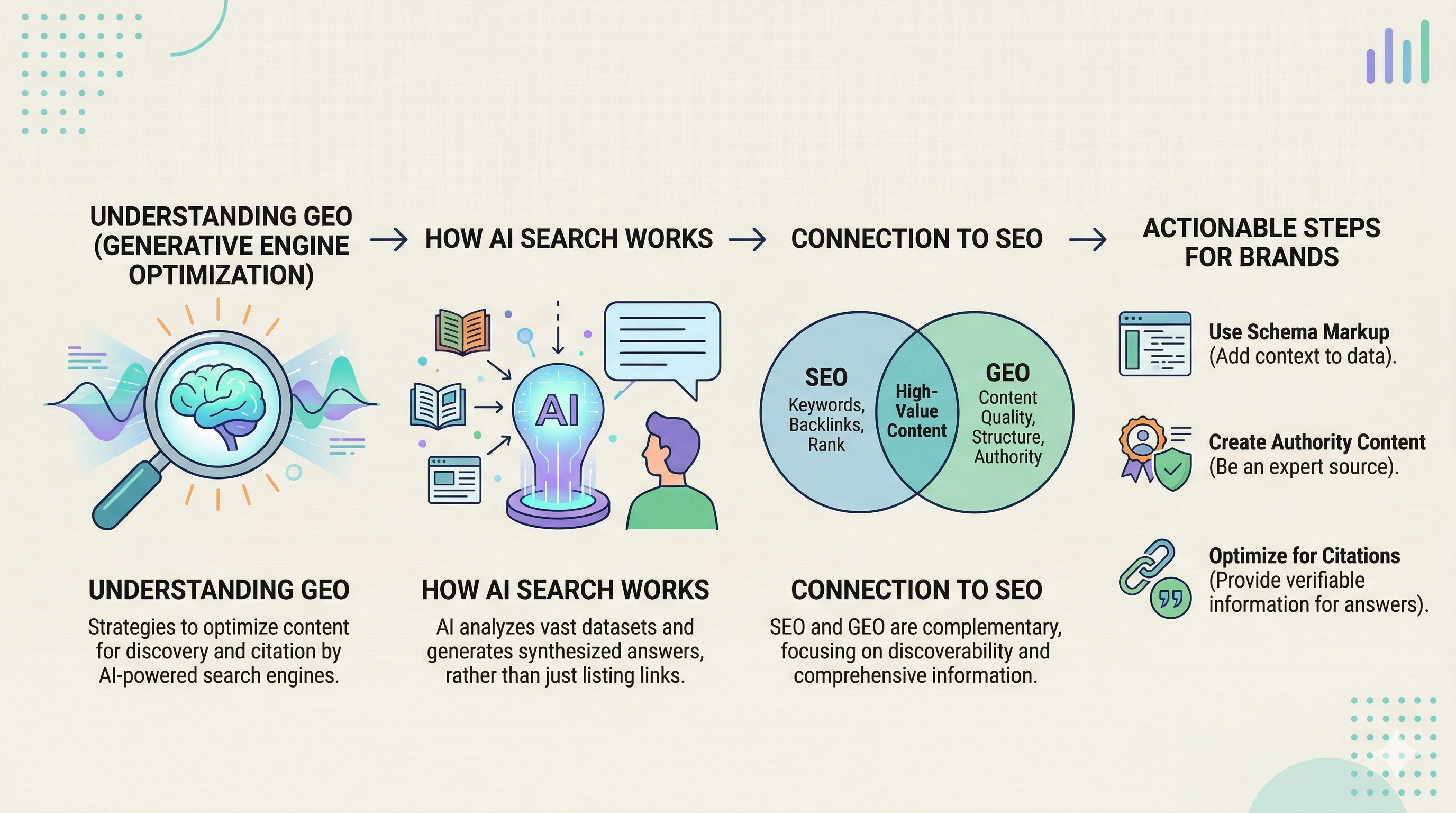
Generative Engine Optimization, or GEO, is the work of helping your website become easy for AI systems to understand, trust, and cite.
In old-school SEO, the main goal was often to rank a page high in a list of blue links. In GEO, the goal is wider. You want your brand, content, facts, and pages to show up inside AI-generated answers, AI Overviews, LLM tools, and follow-up searches.
A simple way to think about GEO is this: SEO helps search engines find your page. GEO helps AI systems understand why your page should be used when they build an answer.
GEO is not a replacement for SEO. It is the next layer on top of solid SEO, content quality, and brand trust.
How AI search is different from classic search
People now search in longer, more natural language. They ask questions the way they talk. That changes what kind of pages win attention.
- Classic search often shows a list of pages. AI search often gives a combined answer with supporting links.
- Users now ask multi-step questions, comparisons, and follow-up questions instead of one short keyword.
- AI systems look for pages with clear meaning, strong topical coverage, and trustworthy evidence they can reuse.
- Being cited matters more. Sometimes the win is not only a rank, but a mention, a supporting link, or a branded answer.
- User satisfaction matters more because weak pages are easier to skip when AI can summarize many sources fast.
Where GEO shows up today
This is why GEO is bigger than one platform. Good GEO work improves your chance of appearing wherever AI systems need reliable web information.
- Google AI Overviews and AI Mode
- LLM tools that answer questions with or without web citations
- Perplexity, Gemini, and other AI research experiences
- Voice assistants and conversational search interfaces
- Organic search journeys where users compare sources after reading an AI answer
Why SEO still matters in the AI era
A lot of people think GEO is a brand-new game with completely new rules. That is not what Google says. Google's official AI features documentation says the best practices for SEO still matter for AI Overviews and AI Mode, and there are no extra requirements to appear there.
That means your basics still matter: crawling, indexability, page speed, internal links, structured data that matches the visible page, and useful content written for real people.
If your technical SEO is weak, AI systems have less reliable material to work with. If your content is thin, copied, or vague, AI systems have less reason to trust and cite it.
If you're auditing technical spam risk alongside GEO, see our back-button hijacking audit for Django and no-code stacks.
What makes a page easier for AI systems to use
- A clear title and a strong main heading
- Direct definitions near the top of the page
- Simple section structure with helpful subheadings
- Original insights, examples, screenshots, or first-hand experience
- Named entities such as brands, tools, people, products, and concepts used consistently
- Internal links that show how pages relate to each other
- Schema markup that supports what users can already see on the page
A practical GEO starter checklist
Choose one topic cluster
Start with one topic you truly know well. For example: GEO, AI blog writing, sitemap health, or technical SEO for SaaS.
Build a topic system, not one isolated page
Create a main guide, a few supporting blogs, a glossary, and tool or service pages that connect naturally through internal links.
Add strong author and business trust signals
Show who wrote the content, why they are qualified, how to contact the brand, and what experience backs the article.
Use simple language and direct answers
Write so both a human reader and a retrieval system can quickly understand what your page says.
Keep facts fresh
Review dates, examples, screenshots, tools, and Google guidance regularly so the page stays useful and current.
Common GEO mistakes to avoid
- Publishing many weak pages on random trending topics
- Using AI to rewrite what already exists without adding insight
- Ignoring internal links and letting related pages stay disconnected
- Adding schema that does not match visible content
- Writing long articles that never answer the main question clearly
- Skipping author trust, citations, and first-hand proof
My Personal Experience with GEO (by Sandesh Kokad)
When I first heard about Generative Engine Optimization, I thought it was just a new buzzword. But as I tested LLM tools to find software solutions and marketing trends, I noticed something huge. The sites the AI systems quoted often weren't the ones ranking #1 on traditional Google search.
My personal turning point was optimizing our client platforms for deeper entities rather than exact-match keywords. Creating content directly for users and ensuring definitions were crystal clear—that was the actual trick.
As an engineer and marketer, my biggest lesson is to stop overcomplicating things. Clear structure, undeniable facts, and direct answers matter more than SEO tricks now.
Sources and references
These are the main primary sources behind the guidance and date-sensitive notes in this article.
Google explains that SEO best practices still apply to AI Overviews and AI Mode, and that there are no extra AI-only requirements.
Google's core guidance on original, useful content, first-hand expertise, and people-first publishing.
Google's official explanation that quality matters more than whether content is written with AI or not.
Useful next steps on SEOWebGrow
Frequently asked questions
Is GEO different from SEO?
Yes, but they work together. SEO helps search engines discover and rank pages. GEO helps AI systems understand, trust, and use your content in generated answers.
Do I need special GEO schema to appear in AI Overviews?
No. Google's AI features documentation says there is no special schema or extra technical requirement just for AI Overviews or AI Mode. Strong SEO basics still matter.
Can a small website still win in GEO?
Yes. Small sites can win when they go deep on a focused topic, show real expertise, and publish clear, original pages that answer real questions better than generic content.
What should I measure for GEO?
Track organic clicks, branded searches, supporting links, AI visibility checks, Search Console performance, and how well your topic cluster earns mentions across related queries.
About the author
Sandesh Kokad
Professional Software Engineer and Digital Marketing Specialist with 5 to 6 years of industry experience
Sandesh Kokad is a Full-Stack Software Engineer and the founder of SEOWebGrow. An ex-MIT student with deep expertise in Python, Django, and Cloud Architecture, he engineers data-driven infrastructure for modern search. As the architect behind SEOWebGrow, he actively builds the infrastructure that helps modern websites communicate seamlessly with AI search engines.