
Community Perspectives
Your Blog Doesn't Need Reddit Karma to Get Into 'Community Perspectives' - Here's What It Actually Needs
Google's Community Perspectives isn't Reddit-only. Here's the exact structural pattern indie blogs need to earn forum-level AI trust signals.
Key takeaways
- Google's "Community Perspectives" is not a Reddit-only feature; it surfaces firsthand, experience-based content from forums, blogs, and niche sites.
- The feature rewards specific extractable properties: self-contained answers, named authorship, first-person narrative, and clear facts.
- Content recency is crucial; articles under three months old are three times more likely to be cited by AI answers.
- Elevating your own blog's comment section and using structured FAQPage schema can earn eligibility for Community Perspectives.
Introduction
I run a one-person SEO/AI tools company. No subreddit with 40,000 members backing me. No "verified community" badge. Just a Django backend on a free Render instance, a Next.js frontend, and a habit of publishing content the day something in search actually changes.
So when Google rolled out Community Perspectives in AI Overviews on May 6–7, 2026, I did what every indie founder with zero Reddit karma did: I panicked for about a day, then went and read the actual Google blog post instead of the fifteen "Reddit stock is up" articles that showed up in my feed.
Here's the thing almost nobody covering this update seems to have actually read closely: Google's own examples for Community Perspectives aren't all Reddit threads. One of them is a photography community talking about shooting the northern lights. Another is an aurora tour company. Another is two gardening websites talking about weeding. None of those are subreddits. They're small, specific, first-person sources - which, if you squint, is a pretty good description of an indie blog that actually knows what it's talking about.
That distinction - platform versus pattern - is the whole article. Let's get into it.
Quick Answer: Can an Indie Blog Get Into Community Perspectives Without Reddit?
Yes. Community Perspectives isn't a Reddit-only feature - it's Google's way of surfacing firsthand, experience-based content wherever it lives, and it explicitly includes forums, social posts, hobbyist sites, and small business/community content alongside Reddit. Google's own rollout post shows examples pulling quotes from a photography forum, an aurora tour company, and gardening websites - not just Reddit threads. An indie blog qualifies if it's written and structured the way a genuinely useful forum comment is written: a real named voice, a specific firsthand claim, and a passage that stands on its own without needing the rest of the article for context.
Reddit doesn't win because it's Reddit. It wins because almost every comment on it is short, first-person, and self-contained - three things most blog posts are not.
What Actually Shipped on May 6–7, 2026 (Not the Rumor Version)
Hema Budaraju, VP of Product Management at Google Search, announced five updates to AI Mode and AI Overviews the same week I was finishing a back-button hijacking audit and an AdSense eligibility audit, so I remember exactly where I was when this rolled out - refreshing Search Console like it owed me money.
The five changes, in plain language:
- Inline links - links now sit next to the specific bullet point or claim they support, instead of being dumped in a source list at the bottom.
- Hover previews - on desktop, hovering a link shows a quick preview of the site before you click.
- A "Subscribed" label - flags articles from publications the user already pays for.
- Article suggestions ("Explore new angles") - a section at the end of the AI answer pointing to related articles and case studies.
- Community Perspectives - quotes and previews pulled from public discussions, social media, and other firsthand sources, shown with the creator's name, handle, or community name so users can decide whether to click through.
Google frames all five as "better web discovery." The company doesn't use words like "click crisis" anywhere in the announcement - which is a very corporate way of not mentioning the elephant in the room. Independent measurement has shown a steep drop in click-through from AI Overviews compared to traditional blue links, and this update reads like an attempt to give users (and publishers) more reasons to actually leave the AI answer and visit a site. Of the five, Community Perspectives is the one that matters for indie publishers, because it's the first time Google has built a UI element specifically to surface lived-experience content inside the answer itself - not below it, not after it, inside it.
Why Everyone Assumed This Is a Reddit Feature
Because right now, it mostly is. Reddit currently drives roughly 40% of AI citations across the major AI platforms, and it's cited more often than Wikipedia, YouTube, or Google's own organic results in aggregate LLM citation studies. So the reflex to say "Community Perspectives = go post on Reddit" is understandable. It's also the wrong takeaway if you're a solo founder or a niche blogger without an existing subreddit presence, because it treats a symptom (Reddit gets cited a lot) as the cause (Reddit's format happens to match what these systems are built to extract).
Flip it around: what does a good Reddit comment actually look like, structurally?
- It's written by a named person (a handle), not an anonymous "Team" byline.
- It answers one specific question in two or three sentences.
- It doesn't require you to have read anything else to understand it.
- It states a firsthand claim ("I tried X, this happened") instead of a general summary.
None of those four properties are Reddit-specific. They're extractability properties. And that's the actual lever an indie blog can pull.
The Real Mechanism: Community Perspectives Rewards a Pattern, Not a Domain
I want to be careful here, because I haven't seen Google publish a ranking factor list for this specific feature, and anyone who tells you they have the exact algorithm is guessing. What I can tell you is what's verifiable from Google's own examples and from my guide on how AI Overviews select sources and quote passages elsewhere. Six things line up consistently.
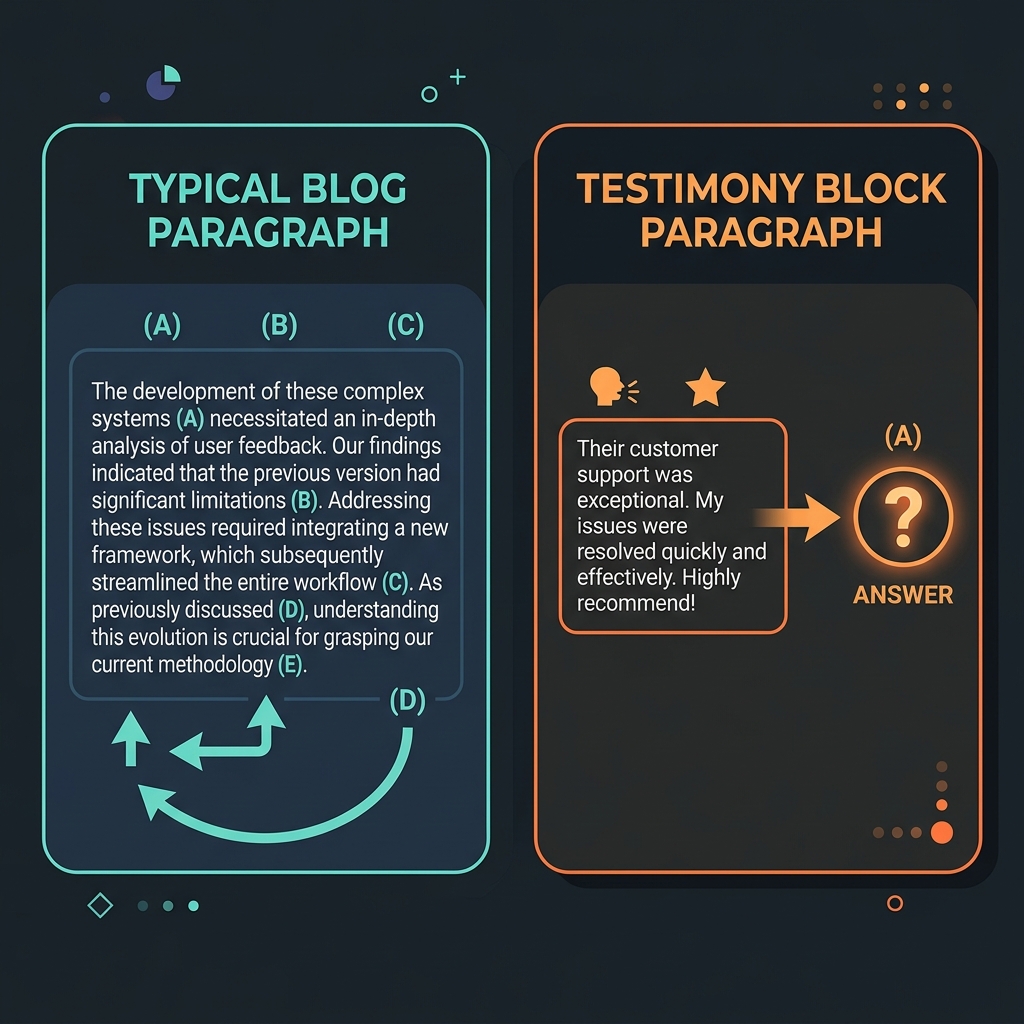
2. "Testimony blocks" - passages written to survive being lifted out of the page
A Reddit comment never depends on the three comments above it to make sense. Most blog paragraphs do - they build on the previous paragraph, use "as mentioned above," or lean on the intro for context. AI Overviews extract passages, not pages, and the single most common reason a well-written blog post gets skipped is that the answer exists somewhere in the article but not in the first sentence of the relevant section.
The fix is a specific writing habit: every section should open with a sentence that would make complete sense to someone who has read nothing else on the page. I now literally test this by copying just the first two sentences of a section into a blank note and checking if they answer the heading's question on their own.
3. Turn your own blog into a small, genuine community - don't fake one
You don't need a subreddit. You need your own comment section to actually work. Most indie blogs either have comments disabled or have a comment section nobody uses. If real readers leave real, specific questions and you reply with real, specific answers, you've built a small forum on your own domain - with the SEO advantage that it's your domain accumulating the trust signal, not Reddit's.
This is slower than posting in an existing subreddit and it will feel like shouting into a room with three people in it for a while. It's also the only version of "community" that compounds and that you fully own - nobody can ban you, shadow-remove your thread, or change their algorithm out from under you the way a subreddit could.
4. One consistent handle, everywhere
AI systems increasingly read the internet's broader mood about a brand or person, not just what's on a single page - if your name shows up consistently across your blog, your GitHub, Indie Hackers, dev.to, and niche communities in your space, that's a corroboration signal. A claim that only ever appears on your own domain is weaker than the same claim echoed by an independent, identifiable source. For a solo builder, "independent source" can simply be you, showing up consistently as the same identifiable person across multiple small platforms, rather than a wall of anonymous marketing copy on one domain.
5. Direct-answer formatting with real FAQ schema
This one isn't new to Community Perspectives specifically, but it stacks with it. Structuring content with a direct answer in the first 100 words and adding properly schema-marked FAQ sections remains one of the highest-leverage, lowest-effort changes for AEO overall. (For a broader technical approach, using an llms.txt Generator and Validator helps make your entire site structure clear to AI agents.) Community Perspectives surfaces voices; direct-answer formatting is what gets the rest of your page pulled into the main AI Overview text around those voices.
6. Recency - because the feature is explicitly about "current" firsthand experience
Content under three months old has been found to be roughly three times more likely to get cited than older material, in analysis specific to AI answer selection. Community Perspectives leans even harder into "what's the current lived experience," because the whole premise of the feature is showing users what real people are saying right now. A firsthand post you wrote two years ago and never revisited is competing against a Reddit comment posted this week. Keep a visible last-updated date, and update the post - not just the date stamp.
What Doesn't Work (And Will Probably Backfire)
- Writing fake "as a customer, I..." testimonials into your own copy. This reads exactly like what it is, both to humans and, increasingly, to the ranking systems trained to spot templated marketing language.
- Buying or seeding fake blog comments. A comment section with five suspiciously enthusiastic one-line comments posted the same day is worse than an empty one.
- Slapping FAQ schema on an article that doesn't actually answer the questions in the FAQ. Google can and does penalize markup that doesn't match visible content.
- Chasing Reddit karma as a proxy metric. Posting low-effort comments across subreddits to "build presence" gets your account shadow-limited faster than it builds any trust signal worth having.
My Own Experience Running This on SEOWebGrow
I'll be honest about where I am with this: I'm mid-experiment, not declaring victory. What changed concretely on my end after this update:
- Every new post gets a byline with my actual name and a one-sentence "what I actually did" line near the top, instead of a generic intro paragraph.
- I rewrote the opening sentence of every H2 and H3 across my published posts so each one answers its own heading without needing the paragraph before it - this took longer than writing the original content did.
- I turned comments back on and started replying to every single one within a day, even the ones that are just "thanks, this helped" - because the two or three genuinely detailed reader questions I do get are exactly the kind of firsthand, specific exchange this feature seems built to surface.
- I stopped treating "community-driven growth" as something that only happens on other people's platforms (Reddit threads, dev.to comments, Indie Hackers posts) and started treating my own comment section as a community-building surface with the same seriousness.
None of this guarantees a Community Perspectives quote. Nothing does - this is an optimization for eligibility, not a guarantee of citation on any specific query. But it's the same instinct that's driven the rest of my content strategy at SEOWebGrow: publish content that says something genuinely new, timed to something real (a Google deadline, a product launch, an actual test I ran), instead of rewriting the same generic advice everyone else already has indexed a hundred times over.
The Checklist
Real byline
Use your actual name, not "Team" or "Admin," on every post to establish named creator identity.
Rewrite opening sentences
Rewrite the first sentence of every section so it stands alone as a complete answer.
Turn comments on
Enable your blog's comments section and actually reply to them to build a localized public discussion.
Use a consistent handle
Use one consistent name/handle across your blog and every external community you post in.
Add FAQ schema
Add FAQ schema only to sections that answer the specific question asked.
Visible update dates
Put a visible "last updated" date on evergreen posts, and actually keep them updated.
Skip Reddit-only playbooks
Build the same firsthand-voice pattern on ground you actually own rather than chasing karma.
You don't need Reddit's audience. You need to write like the best comment in the thread - specific, attributed, and true.
Sources and references
These are the main primary sources behind the guidance and date-sensitive notes in this article.
Useful next steps on SEOWebGrow
Learn how to audit your Django and no-code stack for Google's back-button hijack penalty.
Understand the structural pattern AI Overviews and LLMs use to cite sources.
A beginner-friendly guide to Generative Engine Optimization fundamentals.
Run a quick compliance audit on your site's monetization elements.
Generate a machine-readable llms.txt structure for AI agents.
Frequently asked questions
Does my blog need a large existing audience to appear in Community Perspectives?
No. Google's stated criteria centers on firsthand sources and public discussions, with examples including small niche sites such as a photography forum or a local tour company, not audience size or domain authority.
Do I need to post on Reddit to be eligible for Community Perspectives?
No. Reddit appears often because its comment format naturally matches what the feature extracts, not because eligibility is restricted to Reddit. A blog written in short, self-contained, first-person passages with real named authorship can qualify the same way.
Will adding FAQ schema alone get my blog into Community Perspectives?
No. FAQ schema helps content get parsed for AI Overviews generally, but Community Perspectives specifically surfaces firsthand, community-style voices, which schema alone cannot create if the underlying writing reads like generic marketing copy.
How long does it take to see results from optimizing for Community Perspectives?
There is no published timeline. Google's announcement gave no specifics on rollout speed or region, so this should be treated as a multi-month structural change to how content is written and published rather than a one-week tactic.
Should I disable blog comments if I cannot moderate them heavily?
No. A lightly moderated comment section with a handful of genuine exchanges is more valuable for this purpose than having no comment section at all. Moderate for spam, not for volume.
About the author
Sandesh Kokad
Professional Software Engineer and Digital Marketing Specialist with 5 to 6 years of industry experience
Sandesh Kokad is a Full-Stack Software Engineer and the founder of SEOWebGrow. An ex-MIT student with deep expertise in Python, Django, and Cloud Architecture, he engineers data-driven infrastructure for modern search. As the architect behind SEOWebGrow, he actively builds the infrastructure that helps modern websites communicate seamlessly with AI search engines.