
llms.txt & Google
The llms.txt Contradiction: Why AI Agents Need It, Even If Google Ignores It
Google says llms.txt does nothing for rankings. Chrome audits it anyway. Here's what's actually true, backed by real server-log data on AI agents.
Key takeaways
- Google Search Central explicitly stated in 2026 that llms.txt has zero effect on search rankings or AI Overviews.
- Chrome Lighthouse 13.3.0 shipped an 'Agentic Browsing' audit that checks for llms.txt, creating a perceived contradiction.
- The contradiction is resolved by separating 'discovery' (Google Search) from 'functionality' (Chrome Lighthouse).
- Server logs reveal that llms.txt is primarily fetched by training bots and coding agents, not by AI search and retrieval bots.
- WebMCP is an emerging browser API that allows sites to register specific, callable actions directly to an AI agent.
Quick Answer
Google Search Central confirmed in May 2026, and restated even more bluntly in June 2026, that llms.txt has zero effect on rankings in Search, AI Overviews, or AI Mode - Google Search simply doesn't read it. Nine days earlier, Chrome shipped an "Agentic Browsing" audit inside Lighthouse that checks for the exact same file.
Both statements are true at once because they're answering different questions. One is about being found by a search index. The other is about being usable by an autonomous agent once it's already on your site. llms.txt is worthless for the first job and situationally useful for the second - and almost every article online is arguing about the wrong one.
The timeline nobody laid out in order
Most of the coverage on this topic treats "Google contradicts itself on llms.txt" as a single event. It wasn't. It was three separate moves from two different Google teams, about five weeks apart, and the order matters for understanding what actually happened:
So the "contradiction" wasn't Google flip-flopping. It was the Search team locking the door on a ranking myth in the same month the Chrome team opened a completely different door for a completely different purpose. Two teams, two products, two answers - and almost nobody at Google seems to have coordinated the messaging, which is exactly why the confusion took off on Reddit and Bluesky in the first place.
- May 7, 2026 - Chrome ships Lighthouse 13.3.0. A new "Agentic Browsing" category moves out of experimental status and into the default report, and it includes a check for whether
/llms.txtexists at your domain root. - May 15, 2026 - Google Search Central publishes its first formal AI-optimization guide, Optimizing your website for generative AI features on Google Search. It lists llms.txt, along with content "chunking", under a section mythbusting things you don't need to do.
- June 15-29, 2026 - After community confusion, Search Central adds an explicit subsection stating flatly that the file has no positive or negative effect on visibility because Google Search ignores it, full stop.
The one sentence that actually resolves the debate
When SEO Lily Ray asked Google's John Mueller directly why Google would maintain llms.txt files on its own developer properties while telling everyone else the file doesn't matter, his answer on Bluesky was the cleanest explanation anyone at Google has given.
He said it's worth separating "discovery" - being found via a global search engine - from "functionality": once someone (or something) has already found your page, helping it actually complete a task.
That's the whole contradiction, dismantled in two words: discovery vs. functionality.
llms.txt was never designed to solve the first problem. It was proposed as a way to help language models use a website at inference time - a functionality file, not a discovery file. SEOs adopted it as a ranking hack anyway, and that's the mismatch.
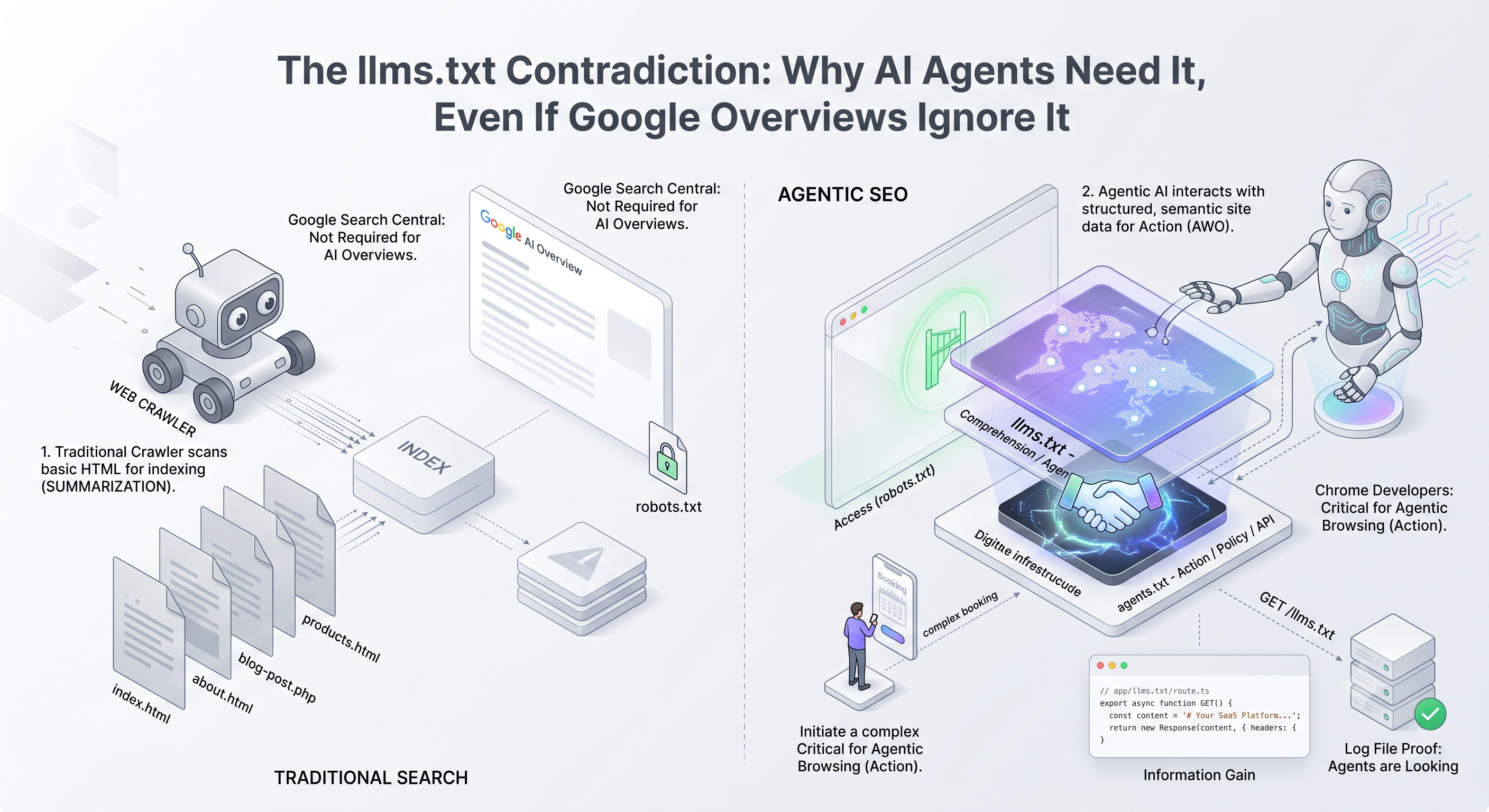
- Discovery is what Google Search, AI Overviews, and AI Mode do. They pull from Google's existing index using retrieval-augmented generation. A markdown file at your root doesn't get you into that index any faster, because the index already has your HTML.
- Functionality is what happens after discovery - when a browser-based agent, a coding assistant, or an autonomous tool is already on your domain and needs to figure out, in seconds, what your site does, where your documentation lives, or what actions it can take.
Summarization vs. action: the split most SEO content still misses
Here's where most coverage of this topic stops - at "llms.txt doesn't help rankings, don't bother." That's an incomplete answer, because it treats AI-agent interaction as a single category when it's actually two separate technical layers with two separate jobs:
The summarization layer is a citation problem: will an AI system quote or link to you when answering a question (AI Overviews, Google Search). Google officially says you don't need llms.txt for this.
The action layer is an execution problem: can an AI agent - Claude, a browser-use tool, an autonomous shopping assistant - actually navigate your checkout flow or call your API (Agentic Browsing). Lighthouse explicitly says llms.txt helps agents move faster.
llms.txt was never a lever for the first problem. It's emerging as one input (not the main one) for the second.
What Lighthouse's Agentic Browsing category actually checks
If you run this audit and expect a 0-100 score like Performance or SEO, you'll be confused. Because the standards for agent interaction are still being written, Lighthouse reports a fractional pass ratio instead of a definitive grade. The category evaluates four things:
- llms.txt presence - a check for a machine-readable markdown summary at your domain root. If missing, it's marked Not Applicable, not failed. It only flags an actual failure if requesting the file throws a server error.
- WebMCP integration - whether your site registers "tools" (specific actions like "search products" or "book a table") that an agent can call directly instead of interpreting pixels on a screenshot.
- Agent-centric accessibility - a filtered slice of the standard accessibility audit: whether interactive elements have programmatic names, whether the accessibility tree is well-formed, and whether interactive content is hidden from assistive systems. Agents use this tree as their primary map of the page.
- Cumulative Layout Shift (CLS) - because an agent that identifies a button's coordinates, then watches the page shift before it clicks, fails the interaction the same way a rushed human would mis-tap on mobile.
Two of those four checks are things well-run sites should already have handled through basic accessibility and Core Web Vitals work. WebMCP is the genuinely new piece - and it currently requires Chrome 150+ and enrollment in an active origin trial, so most production sites will fail or show "Not Applicable" on that check today. That's expected, not alarming.
WebMCP, in plain terms
WebMCP is the part of this story that SEO content almost never explains, because it isn't an SEO feature - it's a browser API. Where llms.txt is a static file an agent reads once for orientation, WebMCP lets your site expose specific, callable actions directly to an agent operating in a user's browser session.
Today, most "AI agent uses a website" demos work by brute force: the agent takes a screenshot, runs vision-language inference to guess which pixel is the "Add to Cart" button, moves a virtual cursor, and clicks. It's slow, it breaks the moment you ship a redesign, and it burns an enormous number of tokens per action.
WebMCP replaces the guess with a declaration. Your site effectively says: "here is a search_products tool, it accepts a query string, it returns a list of matches." The agent calls that tool the way it would call a function, with no screenshot and no pixel-guessing involved.
This is genuinely early. Support is Chrome-only, gated behind an origin trial, and adoption across the live web is close to nil as of mid-2026. It isn't something to retrofit across an entire site this quarter, but it is something worth watching closely if your product has a transactional flow.
- Declarative registration - you add
toolnameandtooldescriptionattributes directly onto your existing HTML form elements. Lighthouse can verify these without executing any JavaScript. - Imperative registration - you register a tool in JavaScript, so an agent can discover it dynamically as the page's state changes.
The log-file proof: what AI bots are actually doing with llms.txt
This is the part most "should you build llms.txt" articles skip entirely, because it requires pulling real server-log data instead of restating Google's guidance. Three independent studies published in the first half of 2026 give a genuinely useful, if slightly conflicting, picture.
The scale study across 137,210 live domains showed that 97% of live llms.txt files were never fetched by anything. The single biggest fetcher wasn't a search or citation bot - it was GPTBot, OpenAI's training crawler, followed closely by Claude Code. AI search and retrieval bots barely showed up.
A smaller 48-day log analysis across one production site found no AI crawler requested llms.txt in practice at all.
A separate 300,000-domain scan corroborated the pattern: GPTBot fetches llms.txt occasionally but rarely; ClaudeBot, Google-Extended, and PerplexityBot effectively don't request it.
The honest takeaway: the bots that do request the file skew heavily toward training and coding-agent crawlers, not the search/retrieval bots that drive citations in ChatGPT, Perplexity, or Gemini answers.
How to check this on your own site
You don't need a third-party tool to see this for yourself - it's a five-minute job in your own access logs:
# Grep your server or CDN logs for requests to llms.txt specifically
grep "/llms.txt" access.log | grep -Ei "GPTBot|ClaudeBot|Claude-Code|PerplexityBot|OAI-SearchBot|Claude-SearchBot|Google-Extended|Bytespider|Amazonbot|MistralAI-User"
If you're on Render, Netlify, Vercel, or any platform where raw access logs aren't trivially exposed, route requests through your CDN's logging (Cloudflare, in particular, makes this straightforward) or add a lightweight middleware log line specifically on the /llms.txt route so you can track hits without parsing your entire log volume.
What you're looking for isn't "did anything hit this file" - plenty of noise (SEO audit tools, Lighthouse runs, GEO-checker scrapers) will show up too. You're specifically looking for the named AI user-agent strings above, and specifically distinguishing training crawlers (GPTBot, ClaudeBot, Google-Extended, Bytespider) from retrieval/citation crawlers (OAI-SearchBot, Claude-SearchBot, PerplexityBot). If your file is only ever hit by the training crawlers and never by the retrieval bots, that's a strong sign the file is doing nothing for your AI Overview or ChatGPT citation visibility today - which lines up exactly with what Google's own documentation already told you.
Implementing llms.txt and WebMCP on a real SaaS stack
If you've decided the functionality case applies to you - you run developer documentation, an API-first product, or a transactional flow you expect agents to attempt - here's what shipping both pieces actually looks like on a modern stack.
A dynamic /llms.txt route in Next.js (App Router)
Static files go stale. A route handler that pulls from your own data layer doesn't:
// app/llms.txt/route.ts
export const revalidate = 3600; // regenerate hourly, or trigger via webhook

export async function GET() {
  const posts = await getPublishedBlogPosts();     // your own data layer
  const tools = await getAvailableApiEndpoints();

  let content = `# YourProduct\n\n> One-sentence description of what this product does.\n\n`;

  content += `## Documentation\n`;
  posts.forEach((p) => {
    content += `- [${p.title}](${p.url}): ${p.excerpt}\n`;
  });

  content += `\n## API\n`;
  tools.forEach((t) => {
    content += `- ${t.name}: ${t.description}\n`;
  });

  return new Response(content, {
    headers: {
      "Content-Type": "text/plain; charset=utf-8",
      "Cache-Control": "public, max-age=0, s-maxage=3600",
    },
  });
}
The equivalent on a Django backend
For teams running Django rather than a Next.js edge function, the same idea is a plain view with a text/plain response:
# views.py
from django.http import HttpResponse
from django.views.decorators.cache import cache_page
from django.views.decorators.http import require_GET

@require_GET
@cache_page(60 * 60)  # cache 1 hour; invalidate on publish if you need instant updates
def llms_txt(request):
    posts = BlogPost.objects.filter(published=True).order_by("-created_at")[:20]

    lines = ["# YourProduct", "", "> One-sentence description of what this product does.", "", "## Documentation"]
    for post in posts:
        lines.append(f"- [{post.title}]({post.get_absolute_url()}): {post.excerpt}")

return HttpResponse("\n".join(lines), content_type="text/plain; charset=utf-8")# urls.py
path("llms.txt", views.llms_txt, name="llms_txt"),Keep it short, use real markdown headings, link out rather than trying to inline your entire docs into one file (that's what a separate llms-full.txt is for), and regenerate it from your actual content instead of hand-maintaining a static file that drifts out of date within a month.
Registering a WebMCP tool (declarative)
For the action layer, the lightest starting point is annotating an existing form rather than building anything from scratch:
<form
  toolname="search_products"
  tooldescription="Search the product catalog by keyword and return matching items with price and availability."
>
  <input type="text" name="q" />
  <button type="submit">Search</button>
</form>This is intentionally the low-effort path: Lighthouse can verify it statically, it requires no new JavaScript, and it degrades gracefully - human visitors see a normal form, agents see a callable tool. Save the imperative registerTool API for flows that are more dynamic than a static form can describe.
Should you actually build this? A decision matrix
Don't build llms.txt because a Reddit thread told you it's the new robots.txt. Build it if your traffic profile matches one of these:
Build it now
Developer-facing products (SDKs, APIs, CLI tools) where coding assistants are a real part of your user base, SaaS platforms with a documented API, or sites that already run Lighthouse in CI/CD.
Deprioritize it
Consumer e-commerce, local businesses, and publishers whose primary growth channel is Google Search, AI Overviews, and AI Mode citations. Google has stated the file does nothing for this.
Watch, don't build yet
WebMCP, for almost everyone. It's Chrome-only, gated behind an origin trial, and support across AI agents in the wild is still minimal. Revisit it when you rebuild a transactional flow.
Free Tools for Agentic SEO Implementation
To help you immediately apply the concepts discussed in this guide, we have built two free tools specifically designed for modern AI compliance:
1. llms.txt Generator
Generate a complete, spec-compliant llms.txt file in seconds. Simply enter your URL, and we'll crawl your site to build the right structure for GPTBot, ClaudeBot, PerplexityBot, and others. Check out our /tools/llms-txt-generator tool.
2. llms.txt Validator
Already have an llms.txt file? Use our validator to get a score out of 100, detect syntax errors, find missing AI crawlers, and receive exact fix instructions. Check out our /tools/llms-txt-validator tool.
Official resources and references
These are the main primary sources behind the guidance and date-sensitive notes in this article.
Useful next steps on SEOWebGrow
Learn how to build a machine-readable brand using llms.txt and agents.txt.
Learn the step-by-step process of creating your own llms.txt file.
Understand the differences between llms.txt and robots.txt.
Generate a complete, spec-compliant llms.txt file for your website instantly.
Validate your existing llms.txt file and get a detailed score with fix instructions.
Frequently asked questions
Does llms.txt help my Google rankings or AI Overviews visibility?
No. Google's Search Central documentation states directly that llms.txt, along with other machine-readable 'AI text files,' has no effect on rankings, AI Overviews, or AI Mode, because Google Search does not use them.
If Google Search ignores it, why does Chrome's Lighthouse tool check for it?
Because Lighthouse's Agentic Browsing category isn't a ranking or SEO audit - it's a readiness check for autonomous browser agents that visit your site directly. This is a separate product built by a separate team for a separate purpose than Google Search.
Is llms.txt an official, standardized protocol like robots.txt?
No. robots.txt is a documented, IETF-standardized (RFC 9309) convention. llms.txt is an independent 2024 proposal with no formal standardization body and no binding requirement that any AI company support it.
Do ChatGPT, Claude, or Perplexity actually read llms.txt when deciding what to cite?
Server-log evidence as of mid-2026 doesn't support that. The AI bots that do fetch llms.txt files skew heavily toward training and coding-agent crawlers (GPTBot, Claude Code), not the search/retrieval bots that drive live citations.
What is WebMCP, and is it different from llms.txt?
Yes, and they solve different problems. llms.txt is a static file that gives an agent orientation context. WebMCP is a browser API that lets your site register specific, callable actions (like 'search' or 'book appointment') that an agent can invoke directly instead of guessing from a screenshot.
Should a SaaS company build llms.txt?
If your users include developers or AI coding agents that need to understand your API or docs quickly, yes - it's a low-cost, low-maintenance file. If your growth depends on Google Search visibility, building it won't move that needle either way, so treat it as optional infrastructure, not a priority.
Is this likely to change?
Almost certainly, and quickly. Google's own guidance shifted meaningfully within a single month in 2026, WebMCP is still an active origin trial, and the agentic web standards are explicitly described as still emerging.
About the author
Sandesh Kokad
Professional Software Engineer and Digital Marketing Specialist with 5 to 6 years of industry experience
Sandesh Kokad is a Full-Stack Software Engineer and the founder of SEOWebGrow. An ex-MIT student with deep expertise in Python, Django, and Cloud Architecture, he engineers data-driven infrastructure for modern search. As the architect behind SEOWebGrow, he actively builds the infrastructure that helps modern websites communicate seamlessly with AI search engines.